- Call Us: +(92) 300 099 9528
- Email: info@albakhtquran.com
Makharij for Beginners: 5 Elite Pillars for Perfect Recitation
Makharij for Beginners: 5 Elite Pillars for Perfect Recitation
Every parent remembers the milestone of their child’s first words. But for parents navigating the journey of Quranic studies in the UK, USA, or Canada, a new challenge often arises: the subtle, technical struggle of Arabic phonetics.
You might notice your child using a soft “s” sound for both Seen (س) and Saad (ص), or perhaps the deep, breathy Ha (ح) sounds identical to the lighter Ha (هـ). It is frustrating to hear these mistakes and not know exactly how to help them correct the “shape” of the sound. This is where the science of Makharij (Articulation Points) becomes the bridge between basic reading and true recitation excellence. For parents looking into Makharij for beginners, understanding these physical mechanics is the first step toward supporting a child’s progress.
Why “Close Enough” Isn’t Enough in Tajweed
In English, a slight accent change rarely alters a word’s meaning. In the Quran, however, the precise point where a letter originates—the Makhraj—is critical. Shifting a sound just a few millimeters forward or backward in the mouth can change a word from “Creator” to “He created.” This level of precision is why how to improve Quran pronunciation is often a technical journey rather than just a repetitive one.
To truly master Tajweed Articulation Points, we must look at the mouth as a sophisticated instrument. There are five primary “neighborhoods” where letters are born. When children learn Makharij for beginners, they move beyond simple mimicry and begin to understand the anatomy of sound. According to phonetic research by institutions like Oxford University, the precision of speech sounds is dictated by the exact placement of the tongue and vocal tract.
Achieving authentic articulation requires real-time correction. If you are looking to establish a structured foundational baseline for your household, you can consult with a professional online Quran teacher in the UK through our dedicated British instruction track.
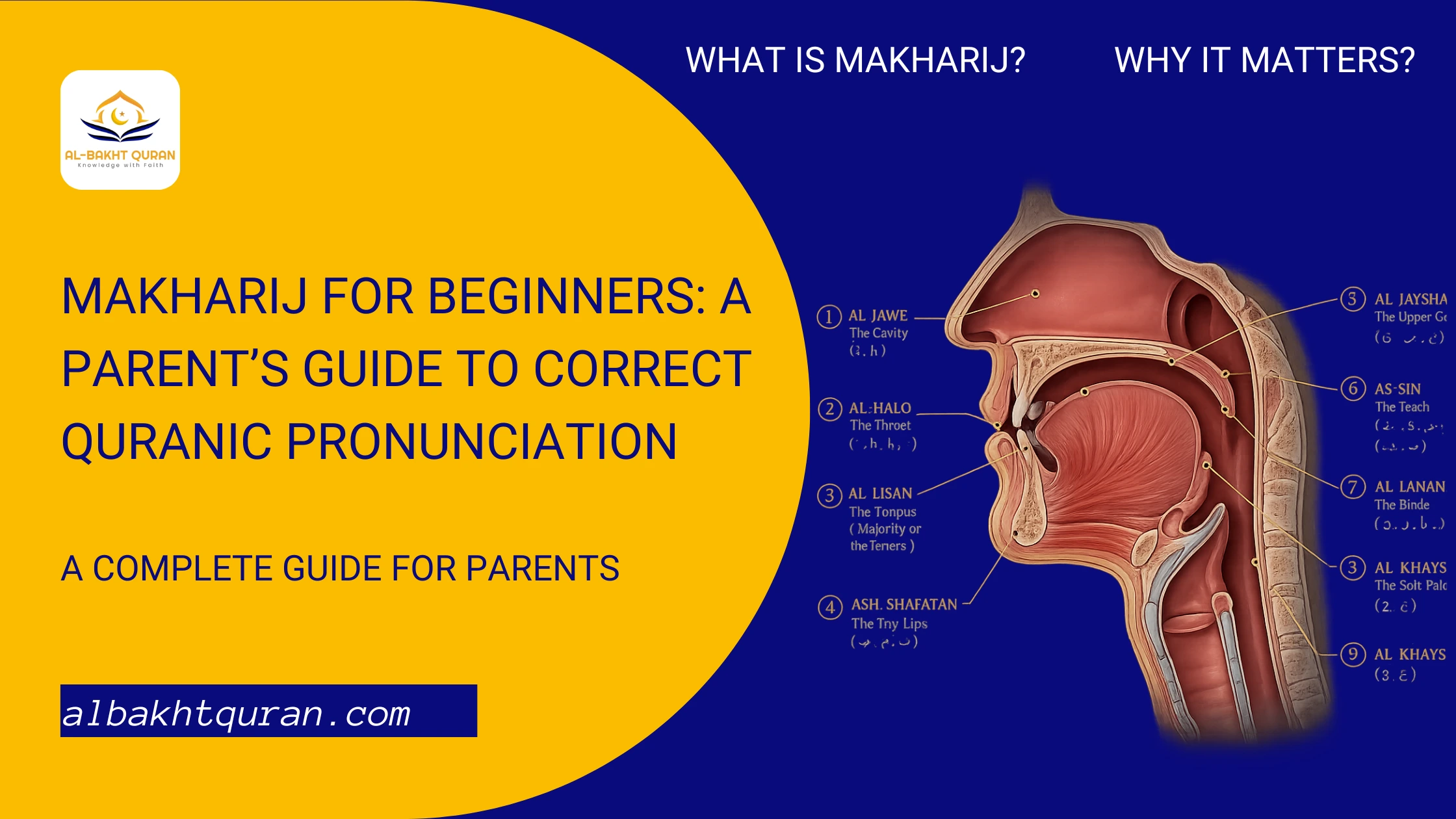
The 5 Main Areas of Tajweed Articulation Points
Alt Text: Makharij for Beginners
- The Throat (Al-Halq): This is the deepest area, responsible for six specific letters. It is divided into the deepest part (closest to the chest), the middle, and the top (closest to the mouth). Many students struggle here because these sounds do not exist in the English language. Mastery of Makharij for beginners starts with recognizing these deep vibrations.
- The Tongue (Al-Lisan): The most complex area, producing 18 letters. It involves the tip, sides, and back of the tongue hitting specific points on the teeth or palate. Mastery of the tongue is the most significant factor in how to improve Quran pronunciation.
- The Lips (Ash-Shafatain): Used for letters like Ba, Meem, and Waw. Whether the lips are pressed together, rounded, or touching the teeth, the precision here determines the clarity of the recitation. This is a core part of Makharij for beginners.
- The Nasal Cavity (Al-Khayshum): This isn’t for specific letters, but for the “Ghunnah” (nasal sound). It provides the melodic, soulful resonance that characterizes high-level Tajweed.
- The Oral Cavity (Al-Jawf): The “empty space” in the mouth and throat used for long vowel sounds (Madd). This is where the sound is sustained and projected, a vital concept when studying Makharij for beginners.
The Necessity of 1-on-1 Expertise
While apps and videos are helpful supplementary resources, they lack a critical component: real-time feedback. Because a child cannot “see” the back of their own throat or the exact placement of their tongue against their molars, they need a phonetics expert to listen and adjust their output.
A professional teacher provides the “ear” that identifies a “heavy” letter being pronounced “lightly.” Professional 1-on-1 correction ensures that Makharij for beginners is taught with precision from day one, preventing the solidification of bad habits that can take years to “un-learn” later in life. This is the gold standard for parents who want to see genuine, lasting improvement in their child’s recitation and understand how to improve Quran pronunciation effectively.
Quick Summary Table for Parents
| Articulation Area | Arabic Name | Key Function |
| Throat | Al-Halq | Deep, mid, and upper throat sounds (e.g., Ha, Kha). |
| Tongue | Al-Lisan | Precise placement against teeth/palate (18 letters). |
| Lips | Ash-Shafatain | Closing or rounding the lips (e.g., Ba, Meem, Waw). |
| Nasal Cavity | Al-Khayshum | The source of the resonant Ghunnah (nasalization). |
| Oral Cavity | Al-Jawf | The empty space for stretching long vowel sounds. |
Moving Toward Mastery
Understanding the theory of Tajweed Articulation Points is an excellent start, but the application is where the beauty of the Quran truly shines. As a parent, your role is to provide the environment and the expert guidance your child needs to flourish. For further reading on the importance of phonetic accuracy in liturgical languages, you can consult resources from the Linguistic Society of America.
If you notice your child is hitting a plateau or struggling with specific letters, it may be due to common phonetic hurdles that require a specialized approach.
- Deep Dive: Explore our detailed guide on the 5 Reasons Students Struggle with Tajweed to identify exactly where your child might be getting stuck.
- Professional Audit: Is your child’s how to improve Quran pronunciation journey on the right track? Don’t leave it to chance. Book a Free Evaluation with our phonetics specialists today to receive a personalized, institutional-grade Tajweed assessment.
Fequently Asked Questions about Makharij for Beginners
What is the best age for a child to start learning Makharij?
While children can begin recognizing sounds as early as age 4 or 5, the technical study of Makharij for beginners usually becomes most effective around age 7. At this stage, children have the muscle control and focus required to understand the specific Tajweed Articulation Points.
Can my child learn correct pronunciation without a teacher?
It is extremely difficult. Because how to improve Quran pronunciation relies on internal muscle movements (like the position of the tongue against the soft palate), a student cannot hear their own mistakes clearly. A qualified teacher acts as a “human mirror” to provide immediate phonetic correction.
How long does it take to master all the articulation points?
Every child is different, but with consistent 1-on-1 practice, most students can understand and apply the primary Makharij for beginners within 3 to 6 months. Mastery and fluency, however, come through long-term recitation and “muscle memory” development.
Why does my child struggle with letters like ‘Saad’ and ‘Dhaad’?
These are “heavy” letters that do not exist in English phonetics. They require a specific elevation of the back of the tongue. Learning these Tajweed Articulation Points requires specialized exercises that transform these sounds from “impossible” to natural.
Recommended Next Read…
Correct pronunciation is just the first step. Next, you must decide which educational track fits your child’s future. Compare the Hifz vs. Nazra paths here.
Balancing competitive secular schooling with rigorous spiritual development is a common hurdle for diaspora families. To bridge this gap, many parents are enrolling their children in structured, private elite online Quran classes tailored specifically to North American academic calendars and time zones.
Copyright 2026, All Rights Reserved
Leave Your Comments